|
 |
|
 |
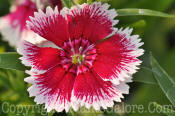
Pinks, Carnation |
 |
 |
|
 |

 This genus consists of annuals,
biennials and
herbaceous perennials. There are over 300 species but only
about 30 are used in landscapes. Pinks and
Carnations have fragrant flowers while the most
common biennial, Sweet William (Dianthus
barbatus) is not fragrant. This genus consists of annuals,
biennials and
herbaceous perennials. There are over 300 species but only
about 30 are used in landscapes. Pinks and
Carnations have fragrant flowers while the most
common biennial, Sweet William (Dianthus
barbatus) is not fragrant.
The generic name is from the Greek word,
dios, meaning the Greek gods Zeus or
Jove and the term, anthos, meaning
flower. Literally, it translates to Jove's
flower. |
|
|

 |
|
|
|
|
 |
| Species |
Foliage
Color |
Hgt
(in) |
Flowers |
Flower
Color |
| D. x allwoodii
|
gray |
12-20 |
2 feets |
various |
| D. alpinus |
green |
3-6 |
solitary |
pink |
| D. barbatus |
green |
10-18 |
clusters |
various |
| D. deltoides |
green |
6-12 |
2 feets |
red, pink |
| D. gratianapolitanus |
gray |
9-12 |
solitary |
rose,
pink |
| D. knappii
|
green |
15-24 |
clusters |
yellow |
| D. plumarsus |
gray |
18-24 |
2 feets |
various |
|
|
|
* Guides and Keys are from the book
"Herbaceous Perennial Plants A Treatise on their Identification,
Culture and Garden Attributes" by
Dr
Allan M. Armitage of the University of Georgia. Varsity Press,
Athens, Georgia. 1989 ISBN 0-942375-00.
More on Dr
Armitage and his other books.
|
|
|
|
This genus is often divided into 5 general
classes:
1. Grass Pinks - low, tufted plants,
sometimes with fragrant foliage.
2. Maiden Pinks - cling close to the ground,
forming dense mats of foliage (D.
deltoides)
3. Biennials - Sweet William (D. barbatus)
with rounded flower-heads.
4. Carnation - (D. caryophyllus)
greenhouse plant.
5. Other species not grown frequently.
|
|
|
|
|