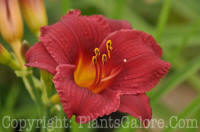
In terms of
popularity, it is hard to beat members of
the genus, Hemerocallis. In recent times,
Hostas have outsold the daylilies but over
the past 50 years, more daylilies have been
sold than any other
herbaceous perennial.
In terms of
popularity, it is hard to beat members of
the genus, Hemerocallis. In recent times,
Hostas have outsold the daylilies but over
the past 50 years, more daylilies have been
sold than any other
herbaceous perennial.
 The genus
name is supposed to come from Greek meaning "Beautiful for a Day." That pretty much
sums it up since each bloom on a daylily is
open for just one day. A whole new set of
blossoms open up the next morning.
The genus
name is supposed to come from Greek meaning "Beautiful for a Day." That pretty much
sums it up since each bloom on a daylily is
open for just one day. A whole new set of
blossoms open up the next morning.
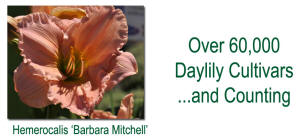
Today, there
are over 60,000 named cultivars of
daylilies. Notice I did not say, "different
cultivars" because many of them look
very, very similar.
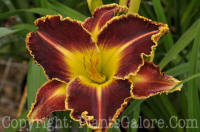 Many, many amateur and professional
hybridizers create and name new cultivars
annually resulting in many lookalikes. There is really nobody
whose job it is to say, "No, that is not a
unique plant. It is just like...so you
cannot give it a name."
Many, many amateur and professional
hybridizers create and name new cultivars
annually resulting in many lookalikes. There is really nobody
whose job it is to say, "No, that is not a
unique plant. It is just like...so you
cannot give it a name."
In the end, the
market makes the final decision based on how many
people buy the plant and how widely grown it
becomes in the garden world. The other, less
unique plants, just fade away in the
hybridizer's (and friend's) garden.
The original
"wild" species were quite different from the
current day cultivars of daylilies. They came from
Eurasia in
Siberia to the
Japanese Islands
to the
Caucasus Mountains. They were brought to
Europe
and made their way to America with the
colonists.
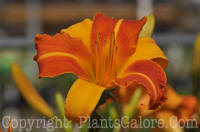 There are a
number of species that have led to the
modern daylily. Hemerocallis
lilioasphodelus is also known as the
Lemon Daylily.
H. fulva was called
the Tawny or Corn Daylily. These two have
escaped cultivation in America and have
"naturalized" throughout parts of the temperate
zones.
There are a
number of species that have led to the
modern daylily. Hemerocallis
lilioasphodelus is also known as the
Lemon Daylily.
H. fulva was called
the Tawny or Corn Daylily. These two have
escaped cultivation in America and have
"naturalized" throughout parts of the temperate
zones.
Other
species involved in the progression of the
genus include H. fulva rosea, H. auranthiaca,
H. auranthiaca major, H. auranthiaca
liltorea, H. altissima, H. citrina, H. damortieri,
H. flora, H. forestii minor, H. middendorffii,
H. plicata, H. thunbergii and H. multiflora.
 People
get confused over the difference between the
daylily (Hemerocallis) and the hardy
lily (Lilium).
People
get confused over the difference between the
daylily (Hemerocallis) and the hardy
lily (Lilium).
Care and Culture of Daylilies